RCC Best Practices for House Construction in Pakistan (2026)
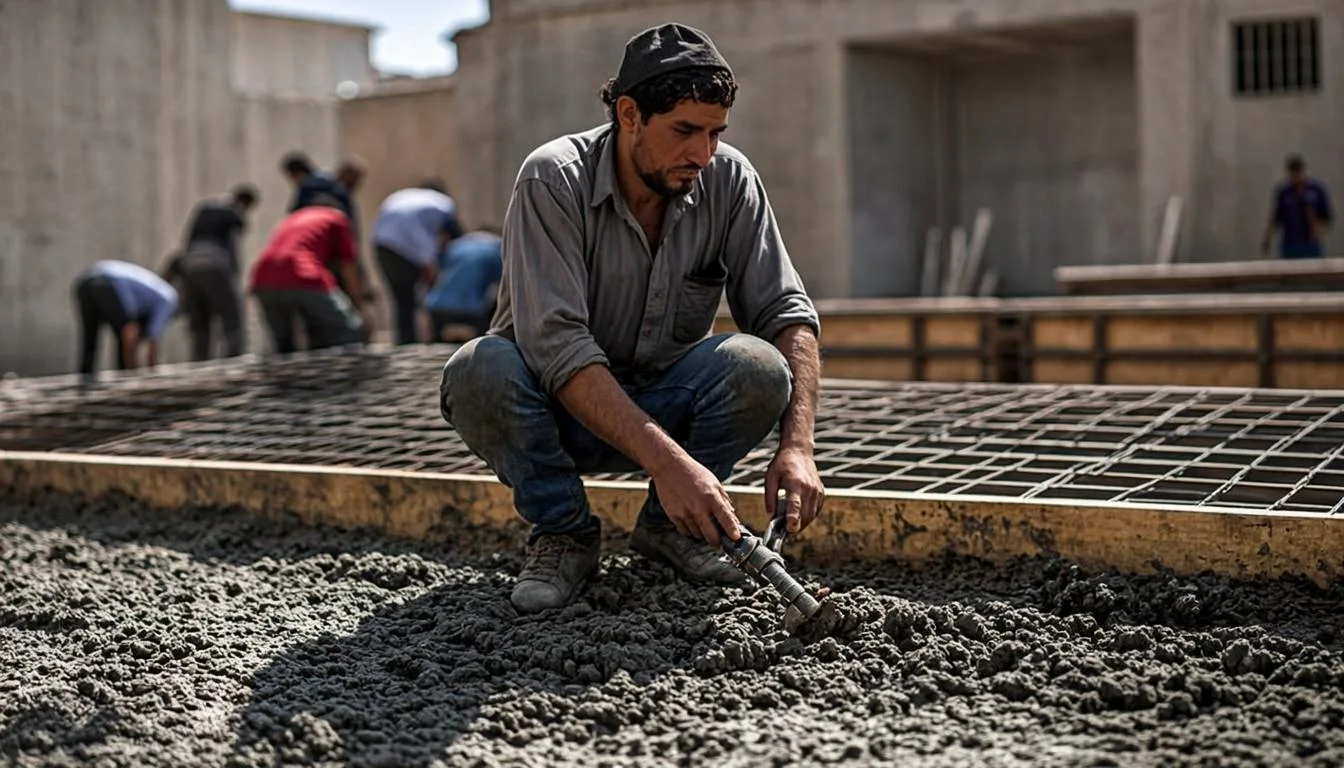
Reinforced Cement Concrete (RCC) is the skeleton of your house — every slab, column, beam and footing you will ever build sits on it. And here is the truth from thirty years on Pakistani sites: almost all RCC failures come from site mistakes, not from design mistakes. Wrong water in the mix, skipped curing, missing cover blocks — small things that quietly cut your slab's strength by 30–40%.
This guide is the practical checklist we give our own customers at Khokhar Builders before every slab pour — the same rules, in plain language, for anyone building a 3, 5, 7 or 10 marla house in Pakistan.
1. Use the Right Mix — and Control the Water
For residential slabs, columns and beams in Pakistan, the standard nominal mixes are:
| Member | Nominal Mix | Typical Use |
|---|---|---|
| Columns, beams, slabs | 1 : 2 : 4 (M20-ish) | Standard for all house RCC |
| Footings, plinth beams | 1 : 2 : 4 or 1 : 1.5 : 3 | 1 : 1.5 : 3 for soft/weak soils |
| Levelling course, paths | 1 : 3 : 6 | Non-structural work only |
The killer is water. Every extra litre of water past the workable point adds voids and shrinks the final strength. A 1:2:4 mix wants roughly 22–25 litres of water per 50 kg bag of cement — a slump you can still shovel, not pour like soup. If the mixer crew keeps asking for "thora aur pani", the answer is no: ask them to improve compaction instead.
2. Slab Thickness and Steel Cover — the Two Numbers That Matter
| Element | Common Pakistani Practice | Good Practice |
|---|---|---|
| Slab thickness (5–10 marla) | 4.5" – 5" | 5" with 2-layer mat on 4" centres |
| Concrete cover (slabs) | Often zero — steel on shuttering | 1" (25 mm) with cover blocks |
| Cover (columns/beams) | ~1" | 1.25"–1.5" |
| Main bar spacing | 6" – 9" centres | Per structural drawing; keep spacing tools on site |
Cover blocks are not optional. Without them, the steel mesh rests on the shuttering, ends up flush with the slab's underside, and rusts — the classic "crazy hairline cracks on the ceiling after 3 monsoons" problem. Plastic or concrete cover blocks cost almost nothing; keep two buckets on site before the pour.
3. Steel Fixing: Laps, Chairs and Wiring
- Lap length: join bars with a lap of at least 50× the bar diameter (a 4-sutar/12 mm bar laps ~2 ft). Stagger laps so they don't line up in one row.
- Chairs: small bent-wire chairs keep the top mat at the right height during the pour. Walk on the steel before pouring — if your feet sink the top mat onto the bottom mat, add more chairs.
- Tie every second intersection with 18–20 gauge binding wire, and fold wire ends down — exposed ends rust and bleed orange stains to the slab surface.
- Grade-60 sariya is the default for slabs now; if you are still choosing sizes, see our steel grades guide and today's sariya rates.
4. Compaction: Vibrate, Don't Just Spread
Concrete placed without compaction carries 5–10% air voids — meaning up to a tenth of the strength you paid for is simply gone. For house slabs:
- Use a needle vibrator in columns, beams and every slab corner (rent one — it costs less than a single repair later).
- On thin slabs, tamping rods work if crews are thorough: poke every 12–15" until paste rises, no honeycombing.
- Watch the shuttering sides during the pour — bubbles and water bleeding out mean compaction is working.
5. Curing — Where Most Slabs Are Actually Lost
Concrete does not "dry" — it cures, gaining strength while kept wet. Skip curing and a slab that should carry 3,000 psi may deliver 1,800 psi.
| Age | Strength Gained (well cured) |
|---|---|
| 3 days | ~40% |
| 7 days | ~65% |
| 14 days | ~90% |
| 21–28 days | ~99–100% |
Minimum 7 days wet curing in winter, 10–14 days in Pakistani summer heat. Pond the slab, or cover with jute bags / sugarcane waste (baggass) and keep it wet round the clock. Columns and beams: wrap and drip-water them. Our full guide on concrete curing days and methods covers this in detail — including the baggass trick.
6. De-Shuttering: Don't Rush the Props
| Member | Minimum Before Removal |
|---|---|
| Slab vertical props (spans under 15 ft) | 14–21 days |
| Beam & slab sides | 2–3 days |
| Beam bottoms | 21 days (or 14 with rapid cement + good curing) |
| Column forms | 24–48 hours |
Removing props early to "re-use shuttering on another site" is how mid-span sags and long-term deflections are born. Mark the pour date on the props with chalk — everyone on site then knows the rules.
7. The 7 Most Common RCC Mistakes on Pakistani Sites
- Extra water for "easy flow" — the #1 strength killer.
- No cover blocks — steel rusts, ceilings crack.
- Curing skipped or 2-day only — slab never reaches design strength.
- De-shuttering after 7 days — props gone before strength arrives.
- Laps too short / all in one line — weak joints exactly where moments are high.
- Dirty aggregates — dusty crush and sandy bajri weaken the paste; wash dirty stock before the pour.
- No pour planning — cold joints where one pour ended and the next began hours later. Pour slabs in one continuous operation.
8. Pre-Pour Checklist (print this)
| # | Check | Done? |
|---|---|---|
| 1 | Shuttering level, props tight, no gaps for paste leak | ☐ |
| 2 | Steel diameter, spacing and laps per drawing | ☐ |
| 3 | Cover blocks under every mat, chairs in place | ☐ |
| 4 | Electrical conduits and boxes fixed before pour | ☐ |
| 5 | Cement, sand, crush stocks sufficient for ONE continuous pour | ☐ |
| 6 | Vibrator on site and tested | ☐ |
| 7 | Water source and curing material (bags/baggass) ready | ☐ |
| 8 | Weather check — no pour in heavy rain without covering plans | ☐ |
Run this list an hour before every slab — it takes ten minutes and saves lac-level repairs.
How Much Material Does a Slab Need?
For a 5 marla house slab (roughly 1,400–1,600 sq ft of slab), expect about 180–220 cement bags, 2.5–3 tons of sariya and 8–10 trolleys of crush — but every design differs. Use our free cement calculator and steel calculator for your exact areas, or see the full 10 marla construction cost breakdown for a complete material picture.
Questions on Your Slab?
Khokhar Traders supplies fresh cement, Grade-60 sariya and washed crush across Jhelum city and nearby areas — and we deliver the same day you call. Ring +92 331 5083 648 for current rates, or contact us and tell us your slab size; we will help you plan the pour right.
Delivery Areas & Charges
Plain and simple — here is exactly how delivery works at Khokhar Traders.
Where we deliver: Locally within about 10–15 km of Jhelum city centre — Jhelum City, Civil Lines, Bilal Town, Kala Gujran, Haji Aima, Kotla Aima, Katchery, Mohamdi Chowk, Chishtian Mohallah, Madina Town, CITI Housing, and many more areas around Jhelum city centre. A little further out? We may still be able to deliver with extra charges — just ask.
Delivery charges: Agreed at the time of order. Share your location with our team and we calculate the exact distance, then confirm a fair delivery charge before anything is loaded. Prefer to save on transport? You are welcome to arrange your own transport.
Ex-shop rates vs delivered rates: Shop materials — cement, iron rebars (sariya), chips, tile bonds, paints, hardware — are priced at ex-shop rates: either we deliver at the agreed charge, or you arrange your own transport. Loose materials — sand, aggregate (crush), soil and gassu for foundation filling, and bricks on a full trolley — usually come with delivery included.
Full-truck cement delivery: We can deliver a full truck of 350–500 cement bags straight to your site (if a bigger truck can safely reach it). A small loader carries only 25–35 bags per trip — one full truck saves you many loader runs and real money on local transport.
Rates change daily: A rate confirmed over the phone is valid for that time of day only. A rate is locked with an official order and advance payment — we confirm the final rate and delivery charge together before dispatch.
Full details in our Shipping Policy — or call / WhatsApp +92 331 5083 648 and we will confirm today's rate and your delivery charge in minutes.
Good to Know Before You Act
Two honest notes about everything published in our guides.
Rates are market estimates and they change daily: any price or rate mentioned in our guides is an indicative market estimate for planning only — material rates in Pakistan fluctuate, sometimes daily. It does not matter what a guide, blog or old quotation says — the final and correct rate is always the one our team confirms with you on the day. Call or WhatsApp +92 331 5083 648 for today's exact price. A rate is locked only with an official order and advance payment.
No warranty on results — always speak to a professional first: quantities, mix ratios, material suggestions and methods described in our guides are general educational guidance, not instructions for your specific site. Results after mixing or using any material in any ratio depend on site conditions, water quality, handling, curing, storage and workmanship — we do not warrant or guarantee any result arising from following general guidance. Before you act, always speak with your engineer, contractor or a qualified professional — or ask our team for guidance on materials.
Planning a stage of your project? Contact us first — we will gladly go through your material list, today's rates and the right products for your site before you buy.
Related Articles
Best Month to Start House Construction in Pakistan — A Jhelum Answer
There is no magic month, but there are smart ones. How monsoon, winter and peak season change foundations, curing, mistri availability and material rates — and the two windows local builders actually aim for.
10 Marla House Construction Cost in Pakistan (2026) — Full Breakdown
What a 10 marla house really costs in 2026: grey structure quantities (bricks, cement, steel, sand, crush), labour rates, finishing costs and realistic total budgets from economy to premium.
Marla to Square Feet Conversion in Pakistan (2026) — Plot Size Guide
How many square feet in 1 marla? The full Pakistan plot size guide: marla, kanal, gaz and acre conversion tables for both the 225 and 272.25 sq ft standards, with a free converter and plot division tool.