Concrete Curing: How Many Days to Water Cure Your Slab (Complete Guide)
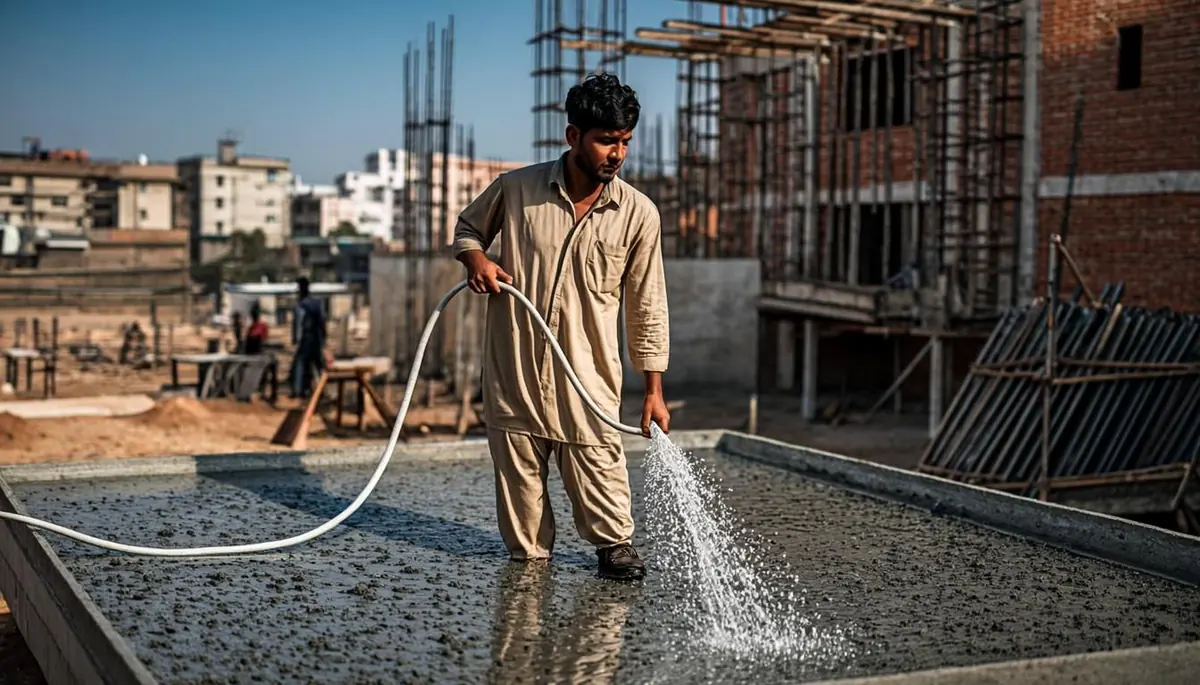
Here is a fact that surprises most homeowners: you can buy the best cement, test the best steel, batch a perfect 1:2:4 mix — and still end up with a slab at half its strength if nobody cures it properly. Curing is free (it costs only water and attention), yet skipped or rushed curing is the single most common quality failure on Pakistani construction sites.
This guide explains what curing actually does, exactly how many days to cure in Pakistan's weather, the best methods for slabs, columns and plaster, and the mistakes that lead to leaks, cracks and dusting floors.
What Curing Actually Does (In Plain Words)
Cement does not "dry" — it chemically reacts with water (called hydration) and grows microscopic crystals that interlock into hard concrete. That reaction needs two things for days on end: enough moisture and reasonable temperature.
If the fresh slab dries out in the sun too early, hydration stops where it stopped. The concrete does not get "a bit late" — it permanently loses the strength it never got. A slab that should reach M20-class strength can realistically end up well below M15-class just from poor curing. That is the difference between a slab that calmly carries its load for 50 years and one that cracks, leaks and dusts.
How Many Days to Cure? The 7 / 14 / 28 Rule
| Concrete Element | Minimum Curing | Ideal in Pakistani Summer |
|---|---|---|
| RCC slab / beams / columns | 7 days | 10 – 14 days |
| Plaster (walls & ceiling) | 5 days | 7 days |
| Brick masonry | 3 days | 5 – 7 days |
| Footings (buried) | 3 – 5 days | 7 days |
- 7 days minimum is the standard rule for OPC concrete in mild weather.
- In Jhelum's summer heat (May–August), wind and temperature pull moisture out of concrete fast — extend to 10–14 days.
- Concrete reaches its design strength at 28 days — but that strength only develops if you cured during the first 1–2 weeks.
Approximate strength gain of properly cured concrete:
| Age | Strength Gained |
|---|---|
| 3 days | ~40% |
| 7 days | ~65% |
| 14 days | ~80% |
| 28 days | ~100% |
Miss the first week and no later care recovers it — the biggest gains happen early, which is also why bad curing is so expensive.
Curing Methods — Best to Acceptable
| Method | How | Best For | Verdict |
|---|---|---|---|
| Ponding | Small earthen bunds divide the slab into ponds; keep 2–3 cm of standing water | Slabs (top surface) | Gold standard — cheapest and most effective |
| Wet jute bags / gunny cloth | Cover surface, keep permanently damp, re-wet 2–3× daily | Columns, sides of beams, plaster | Very good |
| Sprinkling with hose | Gentle spray 2–3 times a day (more in summer) | Everything | Good if someone is diligent — most common on site |
| Polythene sheet | Cover damp surface, tape edges | Difficult-access areas | Acceptable backup; sheet must not dry out underneath |
| Curing compound | Spray-on chemical that seals moisture in | When water is genuinely scarce | Last resort — 60–80% as effective as water curing |
For a residential slab, insist on ponding for at least the first week. It costs almost nothing — a few feet of mud for bunds and daily top-ups — and it outperforms every other method. Columns and beam sides should stay wrapped in wet jute bags during the same period.
When to Start Curing (Timing Matters Both Ways)
- Too early (same hour as pouring): walking on and flooding fresh concrete damages the surface.
- Just right: start as soon as the surface can take light foot traffic with slight print — typically 8–24 hours after pouring. First sprinkle gently, then pond.
- Too late (after 2–3 dry, hot days): the damage is already done. On a hot, windy day, unprotected concrete can lose the surface moisture it needs within 2–3 hours of finishing.
Summer pro tip: pour the slab early morning, finish and start curing the same day, and keep curing through the night the first 3 days — night curing during a heatwave does half the work.
The 7 Curing Mistakes That Crack Slabs
- Wet–dry cycling — watering once a day in June sun means the slab spends most of each day dry. Intermittent curing causes shrinkage cracks; keep it constantly damp instead.
- Curing only the top of the slab — the sides, beams and columns dry out just as fast. Wrap them in wet cloth.
- Stopping at 3 days — "chalo ho gaya" at day 3 captures barely half the potential strength.
- Stacking bricks on the slab at day 4 — the slab is at ~50% strength. Wait until day 7 minimum before light stacking, and spread loads on boards rather than point piles.
- No curing of plaster — uncured plaster cracks in a grid pattern within weeks and those cracks become seepage routes. Sprinkle plaster twice daily for a week.
- De-shuttering too early — slab centering props usually stay 14–21 days (your mason/engineer confirms per span and weather). Removing supports at day 7 to reuse shuttering elsewhere is how floors sag.
- Believing sprinkled water "runs off and wastes" — compared to the cost of re-doing a leaking slab, water is free.
What Poor Curing Costs You Later
- Honeycombed, dusty surfaces that keep shedding sand for years
- Map-cracking across the slab top
- Seepage into rooms below — the crack network you never see is the leak you definitely get. Once that happens, you are into repair mode; our roof and basement waterproofing guide explains the fix, which costs far more than 14 days of water.
- Permanently reduced load capacity — invisible, and the most serious.
Curing FAQ
Can I cure at night only? In peak summer, night-only curing still loses the day. At minimum, wet the surface heavily before noon and again mid-afternoon.
It rained the day after pouring — am I done curing? Rain is excellent curing for the top — but you still continue deliberate curing after; rain days count toward the total.
Does cured concrete still need water after 28 days? After 28 days the slab is self-sufficient. Watering longer does no harm but adds little.
Who is responsible for curing? Put it in writing with your contractor — days, method and who supplies the water. Good builders in Jhelum price curing labour into the quote; a suspiciously cheap quote often quietly skips it.
Building Right, Start to Finish
Pour day is only half the story — the mix design, steel placement and yes, the water afterwards, all decide your slab's life. Read our RCC slab design guide and modern construction techniques used in Pakistan for the full picture. For material delivered to your site — cement, graded crush, Chenab sand — call Khokhar Traders at +92 331 5083 648 or contact us. Quality materials plus proper curing is the whole secret. There isn't a third one.
Delivery Areas & Charges
Plain and simple — here is exactly how delivery works at Khokhar Traders.
Where we deliver: Locally within about 10–15 km of Jhelum city centre — Jhelum City, Civil Lines, Bilal Town, Kala Gujran, Haji Aima, Kotla Aima, Katchery, Mohamdi Chowk, Chishtian Mohallah, Madina Town, CITI Housing, and many more areas around Jhelum city centre. A little further out? We may still be able to deliver with extra charges — just ask.
Delivery charges: Agreed at the time of order. Share your location with our team and we calculate the exact distance, then confirm a fair delivery charge before anything is loaded. Prefer to save on transport? You are welcome to arrange your own transport.
Ex-shop rates vs delivered rates: Shop materials — cement, iron rebars (sariya), chips, tile bonds, paints, hardware — are priced at ex-shop rates: either we deliver at the agreed charge, or you arrange your own transport. Loose materials — sand, aggregate (crush), soil and gassu for foundation filling, and bricks on a full trolley — usually come with delivery included.
Full-truck cement delivery: We can deliver a full truck of 350–500 cement bags straight to your site (if a bigger truck can safely reach it). A small loader carries only 25–35 bags per trip — one full truck saves you many loader runs and real money on local transport.
Rates change daily: A rate confirmed over the phone is valid for that time of day only. A rate is locked with an official order and advance payment — we confirm the final rate and delivery charge together before dispatch.
Full details in our Shipping Policy — or call / WhatsApp +92 331 5083 648 and we will confirm today's rate and your delivery charge in minutes.
Good to Know Before You Act
Two honest notes about everything published in our guides.
Rates are market estimates and they change daily: any price or rate mentioned in our guides is an indicative market estimate for planning only — material rates in Pakistan fluctuate, sometimes daily. It does not matter what a guide, blog or old quotation says — the final and correct rate is always the one our team confirms with you on the day. Call or WhatsApp +92 331 5083 648 for today's exact price. A rate is locked only with an official order and advance payment.
No warranty on results — always speak to a professional first: quantities, mix ratios, material suggestions and methods described in our guides are general educational guidance, not instructions for your specific site. Results after mixing or using any material in any ratio depend on site conditions, water quality, handling, curing, storage and workmanship — we do not warrant or guarantee any result arising from following general guidance. Before you act, always speak with your engineer, contractor or a qualified professional — or ask our team for guidance on materials.
Planning a stage of your project? Contact us first — we will gladly go through your material list, today's rates and the right products for your site before you buy.
Related Articles
Best Month to Start House Construction in Pakistan — A Jhelum Answer
There is no magic month, but there are smart ones. How monsoon, winter and peak season change foundations, curing, mistri availability and material rates — and the two windows local builders actually aim for.
10 Marla House Construction Cost in Pakistan (2026) — Full Breakdown
What a 10 marla house really costs in 2026: grey structure quantities (bricks, cement, steel, sand, crush), labour rates, finishing costs and realistic total budgets from economy to premium.
Marla to Square Feet Conversion in Pakistan (2026) — Plot Size Guide
How many square feet in 1 marla? The full Pakistan plot size guide: marla, kanal, gaz and acre conversion tables for both the 225 and 272.25 sq ft standards, with a free converter and plot division tool.