Brick Types in Pakistan: Awal Class, Doem and Fly Ash
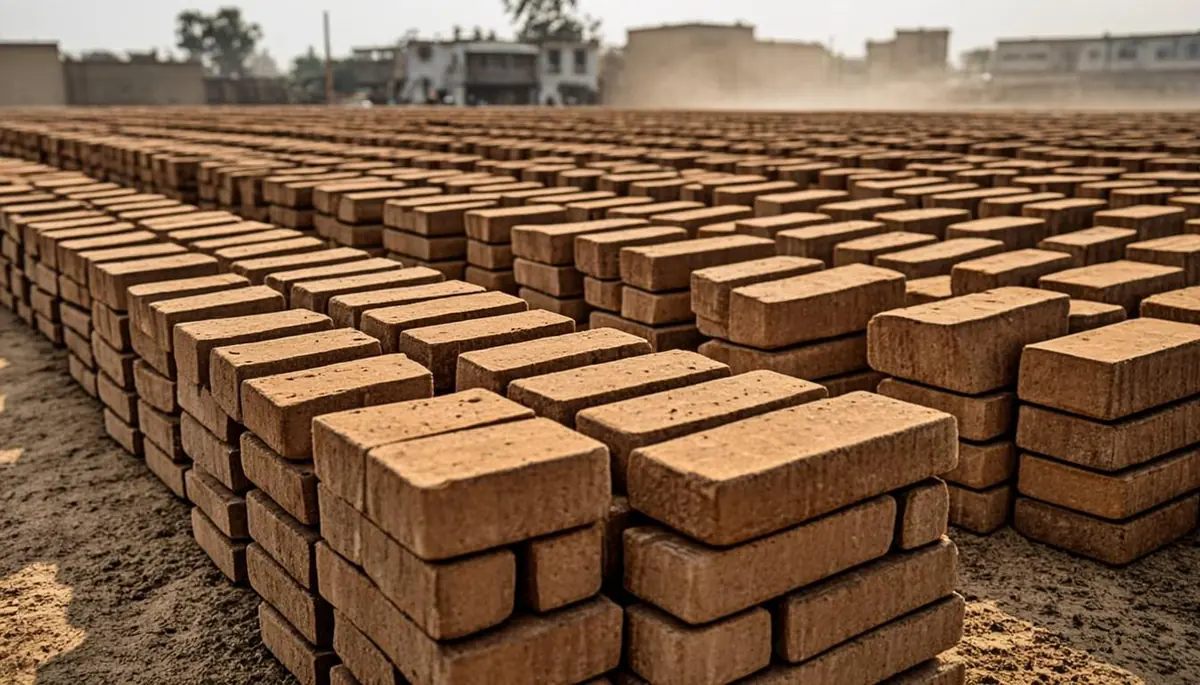
If you have ever gone brick-shopping at a kiln near Jhelum at 7 in the morning, you know the ritual. The kiln owner picks up a brick, holds it to your ear, and taps it with a coin. “Sunno — awal hai.” The good ones ring. The soft ones go thud.
That sound test is older than every brick chart on the internet, and it still works. But between the tap and the trolley, a lot of people get confused about what they are actually buying. So here is the plain version.
The words everyone uses
Awal (first class) bricks — uniform red colour, sharp edges, no big cracks, ring when tapped, low breakage in the stack. These go where the wall matters: foundations, main walls, anything that will carry load.
Doem (second) bricks — the honest middle. Slightly uneven colour, a few rough edges, a handful of cracked ones per hundred. For boundary walls, mortar beds, filling work, septic and soak areas — doem does the job without awal money.
Pakki vs kachchi (over- vs under-burnt) — over-burnt bricks come out dark and twisted; they are extremely hard but irregular, so masons use them for filling. Under-burnt bricks are pale and soft; avoid them for any structural work.
Fly ash bricks — factory-moulded from fly ash, sand and cement, not fired in a kiln. They come out uniform in size and colour, with smoother faces and generally lower water absorption. Some masons love them for neat plaster lines; others stay loyal to clay. Both are used around here — it usually comes down to the mason’s habit and what the job needs.
Three tests at the kiln (that take two minutes)
- The coin tap. Two bricks, one knock. A clear metallic ring means it was burnt properly. A dull thud means soft or under-burnt.
- The drop test. Drop one from waist height, flat. An awal brick survives; a weak one cracks or chips badly.
- The soak test. Leave a brick in a tub of water for a few hours. A thirsty brick that drinks a lot and feels heavy is porous — more mortar-eating, weaker wall.
Also just look around the kiln: if the stack you are buying from has one cracked brick in five, that ratio is going home with you.
Which brick for which work?
There is no single answer — your mason and your drawings decide. What we see most often: awal for foundations and main walls, doem for boundary walls and fill, fly ash where the mason wants uniform courses. Plaster hides the face of the wall anyway, so do not pay extra for looks you will never see.
One practical thing: whatever class you buy, keep the same kiln and the same batch for one phase of the house. Mixing batches mid-wall is how you get courses of slightly different sizes.
Bricks and delivery — how it works with us
Brick rates around Jhelum change day to day, so we do not print a table here — call or WhatsApp +92 331 5083 648 for today’s rate. Bricks-on-trolley rates include delivery: the trolley comes kiln-direct to your site, and the delivery is already part of the agreed rate. Count the stacks at unload before the trolley leaves — this is normal practice, not mistrust. We deliver within roughly 10–15 km of Jhelum city; further out, it might still be possible with extra charges agreed at order time.
Estimate before you order
If you are not sure how many bricks your walls need, use our free bricks calculator, and for a full plot-level number read how many bricks a 5 marla house needs. The calculator gives you a starting figure — your munshi’s wall-by-wall count is the final word.
Before you build
Brick quality affects the whole wall, so involve your mason or engineer in the class decision. Once they say the word — awal, doem or fly ash — call us and we will arrange kiln-fresh stock on trolley.
Delivery Areas & Charges
Plain and simple — here is exactly how delivery works at Khokhar Traders.
Where we deliver: Locally within about 10–15 km of Jhelum city centre — Jhelum City, Civil Lines, Bilal Town, Kala Gujran, Haji Aima, Kotla Aima, Katchery, Mohamdi Chowk, Chishtian Mohallah, Madina Town, CITI Housing, and many more areas around Jhelum city centre. A little further out? We may still be able to deliver with extra charges — just ask.
Delivery charges: Agreed at the time of order. Share your location with our team and we calculate the exact distance, then confirm a fair delivery charge before anything is loaded. Prefer to save on transport? You are welcome to arrange your own transport.
Ex-shop rates vs delivered rates: Shop materials — cement, iron rebars (sariya), chips, tile bonds, paints, hardware — are priced at ex-shop rates: either we deliver at the agreed charge, or you arrange your own transport. Loose materials — sand, aggregate (crush), soil and gassu for foundation filling, and bricks on a full trolley — usually come with delivery included.
Full-truck cement delivery: We can deliver a full truck of 350–500 cement bags straight to your site (if a bigger truck can safely reach it). A small loader carries only 25–35 bags per trip — one full truck saves you many loader runs and real money on local transport.
Rates change daily: A rate confirmed over the phone is valid for that time of day only. A rate is locked with an official order and advance payment — we confirm the final rate and delivery charge together before dispatch.
Full details in our Shipping Policy — or call / WhatsApp +92 331 5083 648 and we will confirm today's rate and your delivery charge in minutes.
Good to Know Before You Act
Two honest notes about everything published in our guides.
Rates are market estimates and they change daily: any price or rate mentioned in our guides is an indicative market estimate for planning only — material rates in Pakistan fluctuate, sometimes daily. It does not matter what a guide, blog or old quotation says — the final and correct rate is always the one our team confirms with you on the day. Call or WhatsApp +92 331 5083 648 for today's exact price. A rate is locked only with an official order and advance payment.
No warranty on results — always speak to a professional first: quantities, mix ratios, material suggestions and methods described in our guides are general educational guidance, not instructions for your specific site. Results after mixing or using any material in any ratio depend on site conditions, water quality, handling, curing, storage and workmanship — we do not warrant or guarantee any result arising from following general guidance. Before you act, always speak with your engineer, contractor or a qualified professional — or ask our team for guidance on materials.
Planning a stage of your project? Contact us first — we will gladly go through your material list, today's rates and the right products for your site before you buy.
Related Articles
Tile Bond vs Cement Mortar for Fixing Tiles — What Actually Holds
Why floor tiles sound hollow within a year, when ordinary cement mortar is fine, when a proper tile adhesive earns its keep, and how far one 20kg bag of tile bond really goes.
White Cement in Pakistan — 7 Everyday Uses We See From Our Counter
Maple Leaf white cement is not just for masons — grout lines, crack filling, elevation borders, pots and crafts. Where white cement beats wall putty, where putty wins, and how to apply it so it stays white.
Sariya Weight Chart: 3 Sutar to 8 Sutar in KG
A customer asked on the phone, “3 sutar saria ka wazan kitna hota hai?” Here is the full chart — and why we still weigh the loaded trolley.